
March 6, 2026
Education is widely recognised as one of the most powerful tools in responding to climate change. The United Nations Educational, Scientific and Cultural Organization (UNESCO) highlights the crucial role education plays in preparing future generations to understand and address environmental challenges. But when it comes to young children, the question is not simply what we teach about climate change — it is how we introduce these ideas in ways that inspire rather than overwhelm.
For young children, learning about climate change begins not with facts or statistics, but with something much simpler: wonder. A fascination with a butterfly, the excitement of spotting a bird, or the joy of playing under a shady tree are often a child’s first connections with nature. These moments of curiosity and discovery are the foundation of environmental awareness.
Early childhood educators understand that before children can care for the planet, they must first feel connected to it. By nurturing that connection, educators help children develop respect and appreciation for the natural world around them. From there, children can begin to understand that the choices people make — even small everyday actions — can affect the environment.
At the Weaver Nest Early Childhood Development Teacher Training Institute in Moyo, Uganda, this philosophy comes to life in meaningful ways. The institute trains future early childhood educators, and part of that training involves modelling how environmental stewardship can be introduced to even the youngest learners.
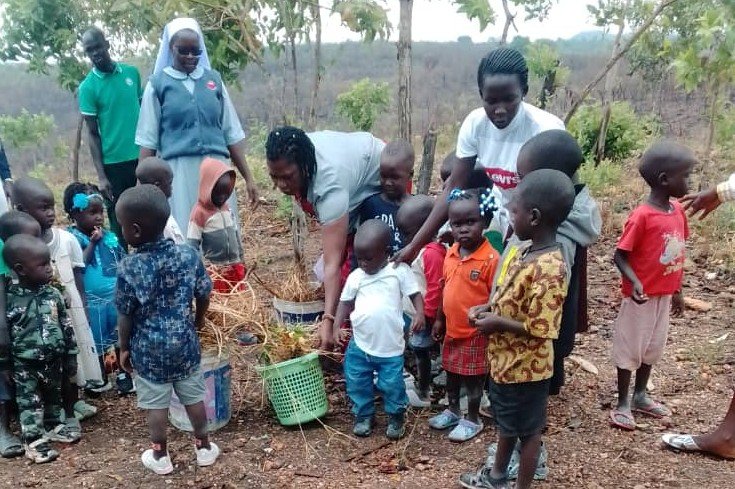
Recently, students at the institute organised environmental activities to mark Africa Environment Day, also known as Wangari Maathai Day. The celebration offered an opportunity not only to raise awareness about protecting the environment, but also to show future teachers how simple activities can inspire environmental responsibility in young children.
Although the training programme was still in the process of resuming, the students who had already returned eagerly took part in the day’s events. They were joined by the institute’s newest learners — the nursery baby class that had just opened the previous week.
The day began with an environmental walk around the school grounds. As students walked together, they observed their surroundings and discussed the potential dangers affecting the environment. The goal was to build awareness and encourage a sense of responsibility within the local community about protecting and managing their environment.
For the youngest participants, learning came through action. The nursery children joined the students and teachers in cleaning the school compound. With gentle guidance, they learned how to place rubbish in designated areas and containers, taking their first small steps in understanding how to care for the spaces they live and play in.
What might seem like a simple activity became an exciting and memorable experience, particularly for the children. Through hands-on participation, they were not just hearing about caring for the environment — they were actively practicing it.
Moments like these highlight the important role educators play in shaping how children see the world. By creating opportunities for exploration, responsibility, and positive action, educators help children grow into individuals who care deeply about their environment.
When young learners are encouraged to connect with nature, understand the impact of human choices, and believe in positive solutions, they develop something just as important as knowledge: hope. And with hope, the next generation will be better prepared to protect the planet we all share.