
May 5, 2026
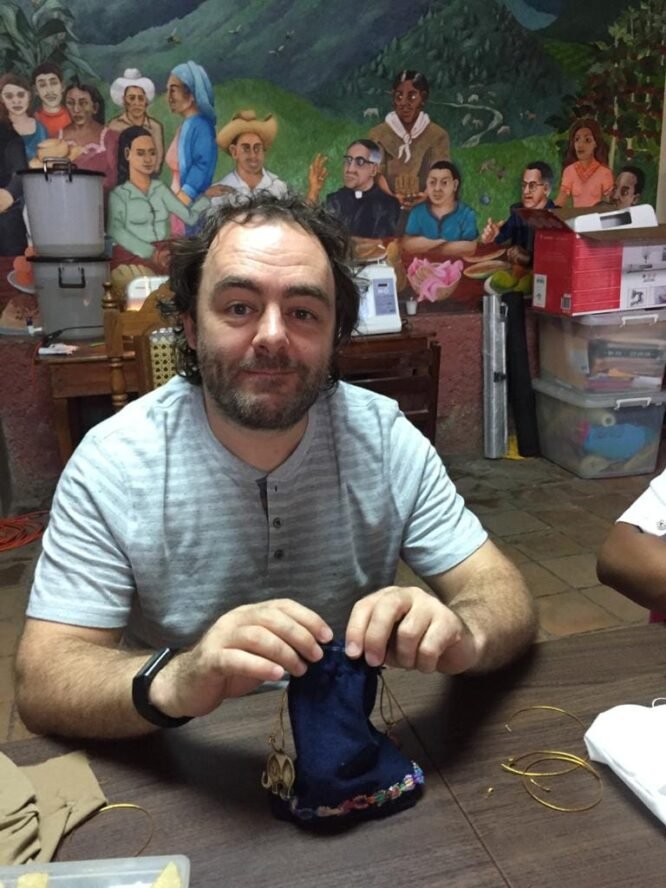
Saint Oscar Romero said that: “before we can call ourselves Christian, we must have a profound humanity”. It is this shared humanity that allows us to connect with peoples of all faiths and none. As Christians we draw our humanity from the Gospels and those who have lived their lives according to the humanity reflected therein. We are links in a chain of faith that is the duty of each generation to forge. Each link different, moulded by the events that give it its distinction. When we tap into our reservoir of humanity we get in touch with our authentic selves and having done that, are propelled on an adventure. Not an adventure in the strictly pleasurable sense but an adventure that incommodes us sufficiently to make us strike new ground.
Why do I mention this and why does it fit into the life of someone who dedicates themselves to mission overseas on a long-term basis? In late January 2010 I began mission in El Salvador. This was the culmination of a long period of discernment. An uneasiness at the world as it was presented to me and a need to broaden my horizons and learn to let go of social norms and try to lead a more authentic life.
To be a lay missionary is no easy task. There is no congregation that will provide security and sustenance. But then anything that is worth doing is never easy. There is no secure funding, no pension plans, and no guarantees. It is just an idea and a hope that you can stay true to that idea.
Being witnesses
But what is the idea you might ask? The idea is that we be witnesses, as we hear in the Acts of the Apostles 1:8 “you will receive power when the Holy Spirit comes on you, and then you will be my witnesses not only in Jerusalem but throughout Judaea and Samaria, and indeed to the ends of the earth.” But what does it mean to be a witness? If you asked me in 2010, I would not have been able to give you an answer. But by my witness of 15 years in El Salvador I am slowly learning what is required and as I mentioned I have been aided by those who preceded me and forged the links in the chain of faith, a chain that does not constrict us but allows us to grow. A chain that grows in an ever-widening spiral. A chain that represents our shared humanity.
To be a witness you need to listen to the people and those who serve among them. To listen to the travesties of war and of the indiscriminate killing of an entire village in the massacre of El Mozote. To listen to first-hand accounts of people having to search for disappeared members of their communities, on the roadsides and in the morgues, of the visits of death squads, of the murder of Saint Oscar Romero for being the voice of those without a voice. Communities that took the teaching of the second Vatican council and the social doctrine of the church to the streets to demand reform.
The community of Sister Anne Griffin
When I first arrived in El Salvador I was welcomed into the community of Sister Anne Griffin. It was through her passionate direction that I got to know the communities affected by the El Mozote massacre. And then, in 2016, I was invited to join the pastoral team of Father Rogelio Ponseele, a Belgian priest and two Salvadoran sisters, Carmen Elena and Ana María. It has been and continues to be a privilege and deeply humbling experience to serve with them. Father Rogelio I first met when I arrived in 2010 whilst working on a project to create a database for the victims of the El Mozote massacre.
He came to El Salvador in 1970 and quickly was caught up in the social upheavals of the time. There was talk of land reform and better labour and social conditions for the people. This was heavily repressed. Father Rogelio and the team of Belgians that arrived on the winds of Vatican II got involved with the social movements and promoted a non-violent struggle. As the repression intensified, they concluded that the people had the right to defend themselves. Indeed, they were directly targeted as part of the repression, having their house searched at the point of a rifle and ultimately having a bomb planted in their home. As a result of this the Belgian team was dispersed.
Father Rogelio opted to stay in the country and went to live in the mountains of northern of Morazán under the protection of one of the opposition groups that grew out of a reaction to the repressive military regime. In all he accompanied the local people and the opposition groups for 12 years, effectively without a roof over his head for most of that time. He was a witness to war and a witness to the response of a people, unwilling to accept the repression of a regime that was at the service of those against the social reforms being proposed. The same sisters I work with now were his link to the outside world. They risked life and limb to cross army checkpoints to bring him supplies and news from the other communities.
Sadly, Father Rogelio died due to injuries incurred in a road accident on the 24th March 2025. It has been the privilege of my life to be part of his pastoral team and see the effects of his 55 years of witness in the communities of the north of Morazán and beyond. And it is our duty as a pastoral team to continue the work he began.
Accompanying the people of God
The defining element of our pastoral work is that we accompany the people. We do not look for protagonism’s or to do work that a local person can do. We do not impose our agenda. It is simply to accompany the people. To be a listening ear. To visit. To maintain hope in difficult times. Returning to the second question posed at the beginning of this article. Does it have to be a foreign missionary and do they have to be there long-term? The short answer is no. However, I do believe it has to be someone who comes from outside the community and can look with an objective eye. I don’t think it is a coincidence that all the members of the pastoral team are not from the area we work. It is also not a coincidence that we are not married or have children. We are not restricted, in that sense, by family responsibilities or by local past histories and we can accompany the people fully.
There is a famous phrase from a Bertold Brecht play (“In Praise of the Fighters”): “There are those who struggle for a day, and they are good. There are those who struggle for a year, and they are better. There are those who struggle many years, and they are better still. But there are those who struggle all their lives: these are the indispensable ones.”
Father Octavio Ortiz struggled all his life, Saint Oscar Romero struggled all is life, Sister Silvia Maribel Arriola struggled all her life and Father Rogelio struggled all his life. They are the indispensable ones, and they leave us a rich legacy that compels us to continue the work they in turn inherited from a previous generation and so the spiral continues and the light grows and dims with the ebb and flow of everyday life.
Speaking with war veterans about the influence that Father Rogelio had on their lives they speak overwhelmingly about his being an embodiment of hope. A light in dark times. A constant in a changing world. He did not bear arms. He came to accompany. One of the commanding officers said that Father Rogelio came to watch over their souls, be they believers or not and to maintain their humanity in a war that can all too easily dehumanise. He won their respect by making their struggles his. That is what it means to accompany the people.
Maintaining hope
Father Rogelio preached that: “when hope is extinguished so too is life extinguished. People stop growing, stop searching, stop struggling. On the contrary they shrink, they sink and they let themselves be carried away by events. If you lose hope, you lose everything.” Maintaining hope does not mean that we do not despair or we don’t become despondent at the events that unfold around us. It is that we can reflect on our daily reality and see that hope will prevail. Saint Oscar Romero makes the case for seeing hope, no matter how difficult the situation: “Here everything is a wreck, a disaster and to deny it is madness. A transcendent salvation is necessary. Upon these ruins the glory of the Lord will shine. Hence, we Christians have a great mission in this hour of our homeland: to maintain hope, to not wait for a utopia as some illusory thing, as if we fall asleep so as not to see reality; but on the contrary, looking at that reality that cannot give anything of itself, and seeing that it can give a lot”. (Homily, 7th January 1979)
Constructing a community is a permanent challenge
Maintaining hope means constant formation, constant questioning, constant dialog. It means respecting each person’s individuality whilst maintaining the connection with the community. As human beings we strive for connection, for identity and for a community that helps us grow. Maintaining hope means resolving conflicts. It means listening and making sure everyone is heard and ensuring that everyone works towards a common goal with a strong sense of justice.
We have a phrase painted on one of the walls of the pastoral centre that reads: “Constructing a community is a permanent challenge”. And it is a challenge that we hope to meet with love and solidarity in the years to come.
In my 15 years in El Salvador, I have seen first-hand what it means to truly know the people. To know four generations of a family. To know the struggles that they have been through. To know where they come from and the history of their home place. To know the past traumas that keep them from leading a full life. Strangely in 15 years I feel I have only just scratched the surface. But the communal knowledge that Father Rogelio had and Carmen Elena and Ana María have, is indispensable in accompanying the people. There are so many inspiring stories of how people overcame traumas and raised their families in the most challenging of conditions.
In terms of the work that I do here as part of the pastoral team, what gives me great satisfaction is the sharing of my love of technology. From play schoolers to software engineers the active sharing of knowledge, the planting of the seeds of curiosity and the formation in values, fills me with a purpose that even the most illustrious career could not provide. The payment is a smile or fruit picked fresh from the tree or vegetables newly dug from the garden or a myriad of other small acts of kindness.
The work of witness, accompaniment and maintaining hope are not defined in any of the UN Sustainable Development Goals and I would argue that no development project would be approved that had them as their objectives. Yet it is what the Gospel calls us to do; it is what our shared humanity should compel us to do, regardless of our beliefs. Much of western society teaches us to focus on our individuality and to limit our sphere of influence to our immediate family. The Gospel and our shared humanity teach us that we should share our talents for the common good. That is the challenge and the adventure that awaits us should we choose to do so.
VC volunteer and lay missionary Dan Ferguson since 2010